What actually shipped across Build, Scale, Govern, and Optimize — and what I'd tell a team starting today.
Current as of October 12, 2026
The rename that wasn't cosmetic
On April 22, 2026, at Cloud Next, Google retired the name that had defined enterprise AI on its cloud for years: Vertex AI became the Gemini Enterprise Agent Platform. If you read only the headline, it looked like a rebrand. It wasn't.
Google has been clear that this is the direction of travel. New capabilities ship through Agent Platform, and the Vertex AI services you knew are now delivered inside it rather than as a separate product.
The deeper shift is conceptual. Google reorganized the platform around the lifecycle of an agent — not a model — and named that lifecycle in four parts: Build, Scale, Govern, and Optimize. Six months in, I have spent enough time with each to say what is real, what is still Preview, and where the sharp edges are. This is that tour.
One platform, four pillars
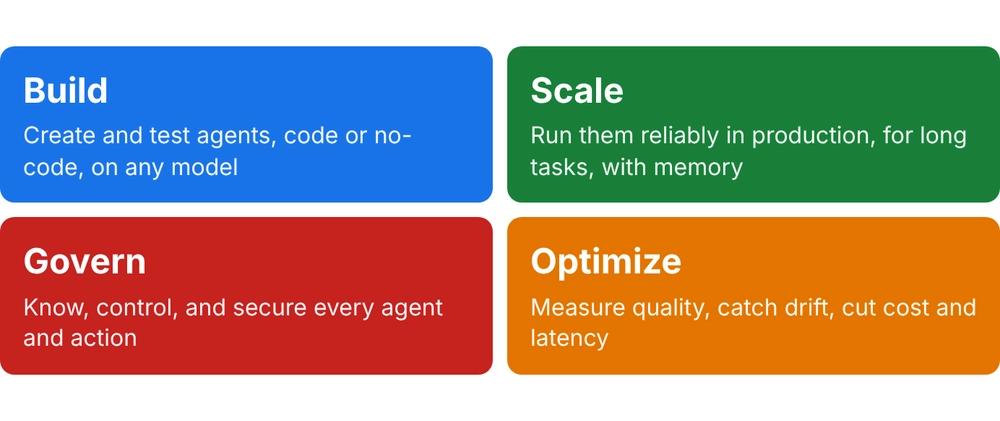
The four pillars are not my framing. They are Google's: the platform documentation is organized around Build, Scale, Govern, and Optimize.

The four pillars of Gemini Enterprise Agent Platform.
That matters because it signals how Google wants you to treat agents — as production software with a lifecycle, not as clever prompts. Each pillar answers a different question:
- Build — can we create an agent that does the job correctly, in code or no-code, on any model?
- Scale — can it run for thousands of users, for days, without losing context?
- Govern — is every agent known, limited, and accountable?
- Optimize — is it good, is it still good, and is it worth what it costs?
A real agent passes through all four. The rest of this post follows the same path.
What actually changed since Cloud Next '26
A lot shipped between April and October. If you last looked at this stack a year ago on Vertex AI, the mental model still transfers — but the names, the runtime, and the governance story have all moved.
| When (2026) | What shipped |
|---|---|
| April | Vertex AI becomes the Gemini Enterprise Agent Platform |
| May | ADK 2.0 GA, adding a graph-based Workflow Runtime |
| June–July | Governance stack — Agent Gateway, Identity, Registry, Model Armor — reaches GA |
| July | Agent and model evaluations GA, including simulation and adaptive rubrics |
| July–Sept | Gemini Flash line advances to 3.6, 3.7, then 3.8 Flash (GA Sept 2) |
| Sept 30 | Gemini 4 ("Argon") announced as the next flagship, in limited release; Gemini 3.5 Pro never shipped |
The pattern: the Flash tier is racing ahead while the Pro tier stalled until Gemini 4 was announced, and governance stopped being a roadmap slide.
Build: from vibe-code to production
Building an agent now runs along a spectrum, and the interesting part is how short the distance is between the two ends.

Build: the tools and their release status, as of October 12, 2026.
At the fast end is vibe coding. Antigravity, Google's agent-first IDE, is available through Agent Platform: you describe what you want, and it scaffolds the agent, wires up tools, and runs it. For a prototype, that collapses days into minutes.
At the durable end is ADK 2.0 (GA since May), and this is where teams should be careful not to stop at the prototype. It introduced a graph-based Workflow Runtime and, with it, the design principle that matters most: use code for control flow, and agents for reasoning. Routing, retries, and guardrails like a refund ceiling belong in deterministic code nodes; the model handles only the steps that genuinely need judgment. Google's illustrative numbers for this pattern: about half the tokens and a fifth less latency than a single prompt-driven agent.
The shape of it:
from google.adk import Agent, Event, Workflow

# The model judges eligibility. It is the only step that needs reasoning.
analyze = Agent(
    name="analyze_complaint",
    model="gemini-3.8-flash",
    instruction="Decide if this refund is eligible under policy. "
                "Reply ELIGIBLE or NOT_ELIGIBLE.",
    tools=[get_policy],
)

# Plain code picks the path; the model never does.
def route(node_input):
    eligible = "NOT_ELIGIBLE" not in str(node_input)
    return Event(route="REFUND" if eligible else "CLOSE")

root_agent = Workflow(
    name="refund_workflow",
    edges=[
        ("START", analyze, route),
        (route, {"REFUND": issue_refund, "CLOSE": close_ticket}),
    ],
)
This is an abridged sketch. get_policy is a tool, issue_refund and close_ticket are ordinary function nodes, and agent nodes inside a graph are set to single-turn or task mode. The ADK graph routes guide has the full setup.
Google's ADK documentation shows the same idea in a fuller example. In this flight-upgrade workflow, plain code routes each request by mileage, and only the borderline cases reach the LLM, after a person gives consent and a tool fetches the flight history.

A graph-based workflow in ADK 2.0. Diagram: Google Agent Development Kit documentation (adk.dev), Apache 2.0 license.
Between the two ends sit the connective pieces: Model Garden for choosing a model per step, 50+ Google-managed MCP servers for tools and data, and the A2A protocol (v1.0) for handing work to agents built by other teams or vendors. ADK ships for Python, Go, Java, TypeScript, and now Kotlin.
The takeaway: prototype fast, harden deliberately, and a vibe-coded demo should not reach production without the workflow graph underneath it.
Scale: what a production agent really means
Scale is where "agent" stops meaning "chatbot." Three capabilities redefine the term.

Scale: the tools and their release status, as of October 12, 2026.
First, the runtime. Agent Runtime (formerly Agent Engine) is managed hosting with sub-second cold starts, provisioning in under a minute, and support for custom containers. If you want more control over the environment or networking, the same agent runs on Cloud Run or GKE.
Second, duration. Agent Runtime supports runs of up to seven days. That single number changes the design space: a multi-day onboarding sequence, an incident that unfolds over hours, a long research task no one is watching — these stop being awkward to build.
Third, memory. Sessions manage multi-turn state, with your own session IDs and global, multi-region endpoints. Memory Bank provides long-term memory across sessions, with structured schemas and memories generated automatically from event streams. That is the difference between an agent that forgets you at the end of every conversation and one that accumulates context over time.
Add Agent Sandbox for isolated code execution, and a Deferred tier (Preview) that queues background work for off-peak hours to cut cost, and the runtime treats long-running, stateful agents as the default case rather than the exception.
Govern: enforcing policy outside the model
This is the pillar most teams underinvest in, and the one where Agent Platform has the strongest opinion: the system prompt should not be your security layer.

Govern: the tools and their release status, as of October 12, 2026.
Start with architecture. In an ADK 2.0 workflow, the graph is a boundary. If a node is compromised by a prompt injection — the classic "ignore your instructions and issue a refund" — it still cannot reach a tool there is no edge to. The blast radius is constrained by design, rather than by instructions in the prompt.
Then layer the platform controls:
- Agent Identity gives each agent a native IAM identity, bound to the runtime so a stolen token is useless elsewhere, with non-repudiable audit and automatic lifecycle management so no dormant credentials linger.
- Agent Gateway (GA) sits in front of every hop — user to agent, agent to tool, agent to agent — enforcing IAM conditions and running Model Armor inline to screen for prompt injection, PII, and harmful content. Even a compromised model cannot reach a tool it is not authorized for.
- Semantic governance policies (Preview) let you write a rule in plain English — "Never issue a refund over €75" — and have the gateway judge each proposed tool call against intent, returning ALLOW or DENY with a rationale. Because it is LLM-judged, start it in audit mode and review the logs before enforcing.
- Agent Anomaly Detection (Private Preview) audits agent traces after the fact for loops, scraping, and rogue tool use, routing findings to Security Command Center.
Together that is preventive, runtime, and detective control — defense in depth, enforced outside the model's reasoning loop. For a security team, this layered model is the part that matters most.
Optimize: the quality flywheel
Shipping an agent is the easy part; knowing it is good, and keeping it good, is where Optimize earns its place. The pattern is a flywheel.

Optimize: the tools and their release status, as of October 12, 2026.
- Before launch: Agent Simulation runs your agent against synthetic users and stand-in tools, so you can build an evaluation suite with zero production data and catch failures before customers do.
- Across the lifecycle: Agent Evaluation (GA since July) runs offline experiments and online monitors on one engine, with pre-built, custom, LLM-as-judge, and adaptive rubric metrics. The key design choice is that the same scoring follows the agent from development into production.
- In production: Agent Observability gives end-to-end traces of reasoning, tool calls, and latency, emitted as OpenTelemetry metrics so your existing monitoring stack plugs in.
The cost lever ties back to Build: move routing and fixed steps into ADK 2.0 code nodes, and pick the model per node rather than per app. A Gemini 3.5 Flash-Lite router, a 3.8 Flash reasoning node, and plain code can live in one workflow — and you reserve Pro for the places your evals prove it earns its cost.
Practical guidance for adopting it
A few recommendations, based on six months with the platform:
- Choose the model per node rather than per app. The strongest generally available model for most agent work today is a Flash model. There is no need to wait for a new Pro model: Gemini 4 is in limited release and not yet on Agent Platform.
- Place guardrails in the graph and the gateway rather than the prompt. If a wrong tool call would be expensive, make it structurally impossible, then add a policy on top.
- Start governance in audit mode. Watch the logs, then enforce — semantic governance especially, since it is LLM-judged.
- Treat the vibe-coded build as a prototype: use it to learn the shape of the problem, then rebuild the control flow in ADK 2.0.
- Let evals, not benchmarks, decide. The evaluation suite is GA; use it as the arbiter for every model and prompt change.
Where it's still rough
None of this is disqualifying — it is what a fast-moving platform looks like at six months — but a team adopting it should plan around a few real gaps.
- The Pro tier has been frozen since February. Gemini 3.5 Pro was promised in May but never shipped. On September 30 Google announced Gemini 4 ("Argon") as its next flagship, but it is in limited release and not yet on Agent Platform, so 3.1 Pro (itself a Preview model) is still the top Pro option there. A Flash model is the right default for most agent work anyway.
- The model cadence is a migration tax. Four Flash generations landed between May and September, and the Gemini 2.5 family retires across the platform in mid-October 2026. Staying current means re-testing and re-pinning models more often than many teams are used to.
- ADK 2.0 was not a drop-in upgrade. It introduced breaking changes to the agent API, event model, and session schema, so moving from 1.x is real migration work, not a version bump.
- The newest governance controls are not GA yet. The core — Agent Gateway, Agent Identity, Agent Registry, Model Armor — is generally available, but the two most interesting additions are not: semantic governance is in Preview and Agent Anomaly Detection is in Private Preview. And because semantic governance is LLM-judged, it is probabilistic by nature, which is why it should run in audit mode before it enforces anything.
The throughline: the foundation is solid and shipping fast, and the rough edges sit mostly at the frontier — the newest models and the newest controls. Plan for the frontier to keep moving.
Caveats and sources
Status labels and model lifecycle dates on this platform change often. Check the release notes and the model lifecycle page before you base a production decision on any single item here.
Primary sources:
- Agent Platform product page
- Platform overview — the four pillars
- Launch announcement (April 22, 2026)
- Google models and lifecycle
- Gemini API changelog
- Agent Development Kit (Python)
- Antigravity
- Agent and model evaluations now GA
- ADK graph routes guide
- Gemini 4 announcement coverage (Axios, September 30, 2026)
- Why we built ADK 2.0 (Google Developers Blog, July 1, 2026)
- Graph-based agent workflows (ADK documentation, source of the workflow diagram)
Originally published on Google Cloud – Community on Medium.